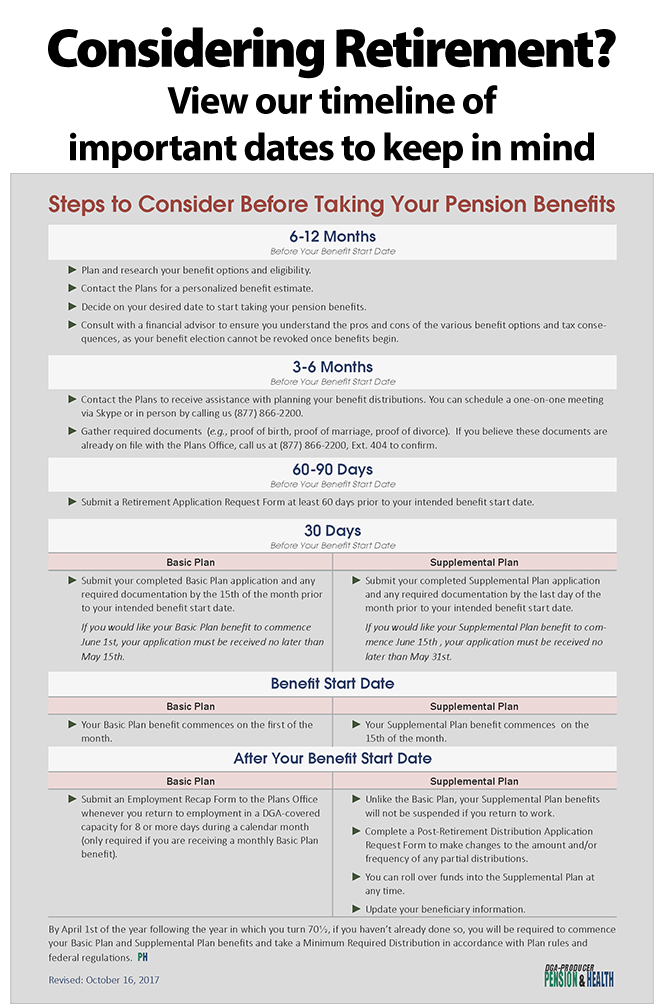
There are two pension plans: the Basic Pension Plan and the Supplemental Pension Plan.
When you work for a DGA-signatory employer under the Basic and Freelance Live and Tape Television Agreements and under the Network Agreement for work on “Other than News, Sports, Operations, Local and Documentary” Programs (i.e., Network Entertainment), for the first $20,000 in reportable earnings, your employer makes pension contributions equal to 8.75% of those earnings. On reportable earnings from $20,001 up to $150,000, your employer makes pension contributions equal to 6.55% of those earnings.
There are other collective bargaining agreements with different employer pension contribution rates. For more information on Collective Bargaining Agreements, visit the Directors Guild of America website at dga.org/contracts.
In accordance with DGA Collective Bargaining Agreements, the Basic Plan also receives contributions that result from the release of films to television and supplemental markets.
To qualify for benefits, you must be vested. There are three ways to become vested:
TEN-YEAR VESTING
A participant is ten-year vested by accruing at least 120 Credited Service Months (CSMs). You can accrue a maximum of 12 CSMs per calendar year. Effective January 1, 2026, to receive the full 12 CSMs in a given year, a participant must earn at least $51,600 in covered earnings (1 CSM for every $4,300). For example, earnings of $51,600 (or more) in a calendar year results in 12 CSMs. Earnings of $9,000 results in 2 CSM ($9,000/$4,300 = 2).
Full benefits are payable at age 65, but reduced benefits can begin as early as age 55.
For more information on ten-year vesting, please refer to page 17 of the March 2025 Pension Plans Summary Plan Description.
FIVE-YEAR VESTING
A participant can achieve five-year vested status with as few as five years of employment. Generally, you become vested under the five-year vesting rules upon attaining five Plan Credit Years, provided there is no permanent Break in Service between any of those Plan Credit Years. A Plan Credit Year is defined as a plan year in which the participant earns the full 12 Credited Service Months. A Permanent Break in Service occurs when a participant earns a Plan Credit Year and, prior to earning another Plan Credit Year, the number of Break in Service Years (or years in which the participant does not earn at least seven CSMs or work at least 51 days in Covered Employment):
You must also have sufficient DGA Covered Earnings in 1999 or later years to qualify for five-year vesting. Pension benefits for participants who are five-year vested are payable at age 65.
For more information on five-year vesting, please refer to page 17 of the March 2025 Pension Plans Summary Plan Description.
ANNIVERSARY VESTING
A participant who has not vested under ten- or five-year vesting, may become anniversary vested if he or she:
For more information on anniversary vesting, please refer to page 19 of the March 2025 Pension Plans Summary Plan Description.
TEN-YEAR VESTING
A participant is ten-year vested by accruing at least 120 Credited Service Months (CSMs). You can accrue a maximum of 12 CSMs per calendar year. Effective January 1, 2026, to receive the full 12 CSMs in a given year, a participant must earn at least $51,600 in covered earnings (1 CSM for every $4,300). For example, earnings of $51,600 (or more) in a calendar year results in 12 CSMs. Earnings of $9,000 results in 2 CSM ($9,000/$4,300 = 2).
Full benefits are payable at age 65, but reduced benefits can begin as early as age 55.
For more information on ten-year vesting, please refer to page 17 of the March 2025 Pension Plans Summary Plan Description.
FIVE-YEAR VESTING
A participant can achieve five-year vested status with as few as five years of employment. Generally, you become vested under the five-year vesting rules upon attaining five Plan Credit Years, provided there is no permanent Break in Service between any of those Plan Credit Years. A Plan Credit Year is defined as a plan year in which the participant earns the full 12 Credited Service Months. A Permanent Break in Service occurs when a participant earns a Plan Credit Year and, prior to earning another Plan Credit Year, the number of Break in Service Years (or years in which the participant does not earn at least seven CSMs or work at least 51 days in Covered Employment):
You must also have sufficient DGA Covered Earnings in 1999 or later years to qualify for five-year vesting. Pension benefits for participants who are five-year vested are payable at age 65.
For more information on five-year vesting, please refer to page 17 of the March 2025 Pension Plans Summary Plan Description.
ANNIVERSARY VESTING
A participant who has not vested under ten- or five-year vesting, may become anniversary vested if he or she:
For more information on anniversary vesting, please refer to page 19 of the March 2025 Pension Plans Summary Plan Description.
Your actual benefit depends on:
| YEAR | EARNINGS | CSMs |
|---|---|---|
| 1998 | $45,000 | 12 |
| 1999 | $45,000 | 12 |
| 2000 | $45,000 | 12 |
| 2001 | $45,000 | 12 |
| 2002 | $45,000 | 12 |
| 2003 | $70,000 | 12 |
| 2004 | $70,000 | 12 |
| 2005 | $70,000 | 12 |
| 2006 | $70,000 | 12 |
| 2007 | $70,000 | 12 |
| 2008 | $90,000 | 12 |
| 2009 | $90,000 | 12 |
| 2010 | $90,000 | 12 |
| Total (13 Years) | $845,000 | 156 |
Divide total earnings/Total CSMs: %845,000/156 = $5,416.67
Multiply that number x 12: $5,416.67 x 12 = $65,000 is your Career Average Earnings.Next, the Plan’s benefit formula is applied to your Career Average Earnings to produce your age 65 benefit. Specifically, the benefit formula is:
| Career Average Earnings | Annual Benefit for Each Year of Service |
|---|---|
| $0-$19,999 | 3.6% of Earnings |
| $20,000-$49,999 | $720 plus 2.5% of excess over $20,000 |
| $50,000-$99,999 | $1,470 plus 1.8% of excess over $50,000 |
| $100,000-$150,000 | $2,370 plus 1.2% of excess over $100,000 |
Then, multiply the resulting amount by the number of years of service (CSMs earned divided by 12). The resulting annual amount cannot exceed $66,000, or $5,500 per month.
For example, using the above Career Average Earnings of $65,000 and 156 CSMs (13 years), your monthly benefit would be $1,885, calculated as follows:| Step 1 | $1,470 + $270 (1.8% of $15,000) | = $1,740 | Annual benefit per year of service |
|---|---|---|---|
| Step 2 | $1,740 x 13 years of service | = $22,620 | Annual benefit at age 65 |
| Step 3 | $22,620 ÷ 12 | = $1,885 | Monthly benefit at age 65 |
At age 65, the monthly benefit of $1,885 would be payable to you for your lifetime. If you have at least 120 CSMs, you may choose to receive benefits as early as age 55, but the monthly amount is reduced to account for a longer benefit pay-out period. Under certain circumstances, you may elect to have a reduced benefit payable over your lifetime with benefits continuing for the life of your spouse or other beneficiary. A lump sum option is also available for participants with at least 120 CSMs (at least one of which must have been earned prior to January 1, 1999) with benefits commencing at age 60 or older. If you are eligible for the lump sum option, the lump sum portion will be based on the lesser of $3,450 or the amount of your accrued benefit as of December 31, 2002; any benefit accrued on or after January 1, 2003, will be paid as a monthly benefit.
When you are ready to commence your benefit, the following payment options will be available to you:
Supplemental Plan contributions made on your behalf are deposited into your own individual account. Under the Basic and Freelance Live and Tape Television Agreements and under the Network Agreement for work on “Other than News, Sports, Operations, Local and Documentary” Programs (i.e., Network Entertainment), after your first $20,000 in DGA-covered earnings, your employer makes pension contributions equal to 2.2% of your earnings up to $150,000 and 8.75% of earnings over $150,000.
There are other collective bargaining agreements with different employer pension contribution rates. For more information on Collective Bargaining Agreements, visit the Directors Guild of America website at dga.org/contracts.
The Supplemental Plan also receives contributions directly from you as a Plan participant, where 2.5% of your reportable earnings is deducted by your employer from your check and submitted with the employer contributions. This amount is credited to your Individual Account.
You can also roll over funds from your other qualified retirement accounts into your Supplemental Plan account and take advantage of the Supplemental Plan’s diversified investment portfolio and solid investment performance record.
To qualify for benefits, you must have an account balance in your Individual Account and be at least age 60. Participants who become disabled (as defined by the Plan) are entitled to benefits regardless of age. If you have not accrued at least 36 CSMs, you may be eligible to withdraw the portion of your account related to your employee contributions and related investment gains or losses; however, you will be forfeiting the portion related to your employer contributions and related investment gains or losses.
The full account balance is available to your beneficiary(ies) upon your death.
The amount in your Individual Account is your benefit. Your account balance is invested with the account balances of all other participants. Our independent investment managers invest the funds in a variety of sound vehicles such as stocks, bonds, real estate, certificates of deposit, etc. Each month, the investment return is calculated and your account is credited with a portion of the investment gains or losses.
When you are ready to commence your benefits, you will have the following payment options available to you:
Any payment option that includes an annuity will use that portion of your account to purchase an annuity from a third-party company. From that point forward, the annuitized benefits are the responsibility of the third-party company.
It is very important for you to check that contributions are being paid into the Plans. The Plans send quarterly statements to each participant who had reported earnings during the quarter. The statement shows the contributions made on your behalf by each of your employers.
The Plans also send all participants an annual statement showing earnings and Credited Service Months accrued as well as pension benefits you may be entitled to.
If your records differ from ours, contact the Contributions Department at (877) 866-2200 ext. 567 as soon as possible so that we can pursue collection on your behalf. Non-receipt of contributions can jeopardize your pension benefits!
For purposes of clarity, the Plans’ provisions have been summarized. We emphasize that nothing in this explanation is intended to change the provisions of the Plans and that only the Board of Trustees is authorized to interpret the Plans. In the event any question is raised, the rights of participants will be determined in accordance with applicable Plans language and by the rules and regulations adopted by the Board of Trustees in the course of the administration of the Plans. The Board of Trustees reserves the right to interpret, alter or amend the Plans. Updated copies of the full Plans documents are available to participants and beneficiaries from the Plans Office.
For more information, please refer to the March 2025 Pension Plans Summary Plan Description.